

Click on your area of interest
All New Releases
Children
Middle School
High School
College
Mixed Choir
Virtuoso
Tenor-Bass Choir
Treble Choir
MultiCultural
Church
Christmas
Unity
HOLIDAY MUSIC

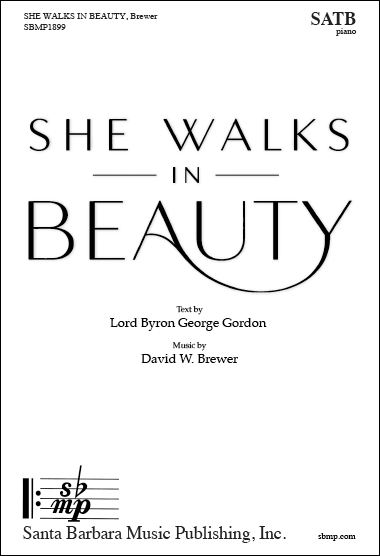 She Walks in Beauty [level: Medium]
 David W. Brewer: Bio and other works
RELEASED: August 2026
voicing: SATB | catalog number: SBMP1899 | duration: 3’49” | price: $2.80accompaniment: piano
Set to a well-known text about the enchantment of love, this gorgeous, lyrical setting is ideal for high school and collegiate mixed ensembles of all levels and sizes. With its supportive piano accompaniment it is a stunning and memorable choice for any concert program.
performance by: Rocky Mountain Chamber Choir [© all rights reserved]
 CLICK HERE: See
and Hear
the Complete Score
or download a perusal copy: HERE
CLICK HERE: See
and Hear
the Complete Score
or download a perusal copy: HERE
CLICK HERE: Read the Text or Poem
She Walks in Beauty
She walks in beauty, like the night,
[a night of] cloudless climes and starry skies;
And all that’s best of dark and bright
Meet in her aspect and her eyes;
She walks in beauty.
One shade the more, one ray the less,
Had half impaired this nameless grace
Which waves in every raven tress,
Or softly lightens o’er her face;
She walks in beauty.
And on that cheek, and o’er that brow,
So soft, so calm, yet eloquent
The smiles that win, the tents that glow,
But tell of days in goodness spent,
She walks in beauty this night!
A mind at peace with all below,
A heart whose love is innocent!
She walks in beauty.
Poem adapted by David W. Brewer
Lord Byron, an English poet and politician, is considered to be one of the leading figures of the Romantic movement. He is still regarded as one of the greatest of the English poets and is widely read to this day. He attended Trinity College, Cambridge (1801-1805) and was well traveled throughout Europe, especially in Italy, where he lived for seven years. He died of a fever in present day Aetolia-Acarnania, Greece in 1824.
The poem She Walks in Beauty is said to have been inspired by an event in Byron’s life in 1814. While attending a party in London, he was entranced by the beauty of Mrs. Anne Beatrix Wilmot (the wife of his first cousin), and the poem was composed that next morning. She Walks in Beauty is one of Lord Byron’s most recognized poems along with such works as Don Juan and Childe Harold’s Pilgrimage.
Lord Byron George Gordon (1788-1824)
She walks in beauty, like the night,
[a night of] cloudless climes and starry skies;
And all that’s best of dark and bright
Meet in her aspect and her eyes;
She walks in beauty.
One shade the more, one ray the less,
Had half impaired this nameless grace
Which waves in every raven tress,
Or softly lightens o’er her face;
She walks in beauty.
And on that cheek, and o’er that brow,
So soft, so calm, yet eloquent
The smiles that win, the tents that glow,
But tell of days in goodness spent,
She walks in beauty this night!
A mind at peace with all below,
A heart whose love is innocent!
She walks in beauty.
Poem adapted by David W. Brewer
Lord Byron, an English poet and politician, is considered to be one of the leading figures of the Romantic movement. He is still regarded as one of the greatest of the English poets and is widely read to this day. He attended Trinity College, Cambridge (1801-1805) and was well traveled throughout Europe, especially in Italy, where he lived for seven years. He died of a fever in present day Aetolia-Acarnania, Greece in 1824.
The poem She Walks in Beauty is said to have been inspired by an event in Byron’s life in 1814. While attending a party in London, he was entranced by the beauty of Mrs. Anne Beatrix Wilmot (the wife of his first cousin), and the poem was composed that next morning. She Walks in Beauty is one of Lord Byron’s most recognized poems along with such works as Don Juan and Childe Harold’s Pilgrimage.
Lord Byron George Gordon (1788-1824)
CLICK HERE: Choral Tracks (Practice made simple)

She Walks in Beauty choral track bundle contains a part dominant track for each voice part, a balanced voices track, and an accompaniment track if the work is not a cappella (the accompaniment is also included with the part dominant and balanced voices track). Get more information and listen to samples HERE. Please note that the choral score is not included in the bundle and needs to be ordered separately.
Price: $49.99 (Each bundle is licensed to be used by up to 50 users)
Please adjust the quantity accordingly if you have more than 50 users.

 This score is available in Printed or ePrint format at checkout
(More Information)
This score is available in Printed or ePrint format at checkout
(More Information)
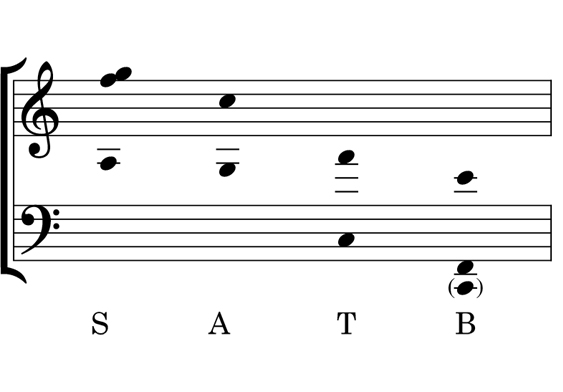
Ranges
Reviews | submit review 

FEATURED OCTAVO
A Tapestry of Sound - SAB
by Daniel Brinsmead
New release from the
Jo-Michael Scheibe Choral Series